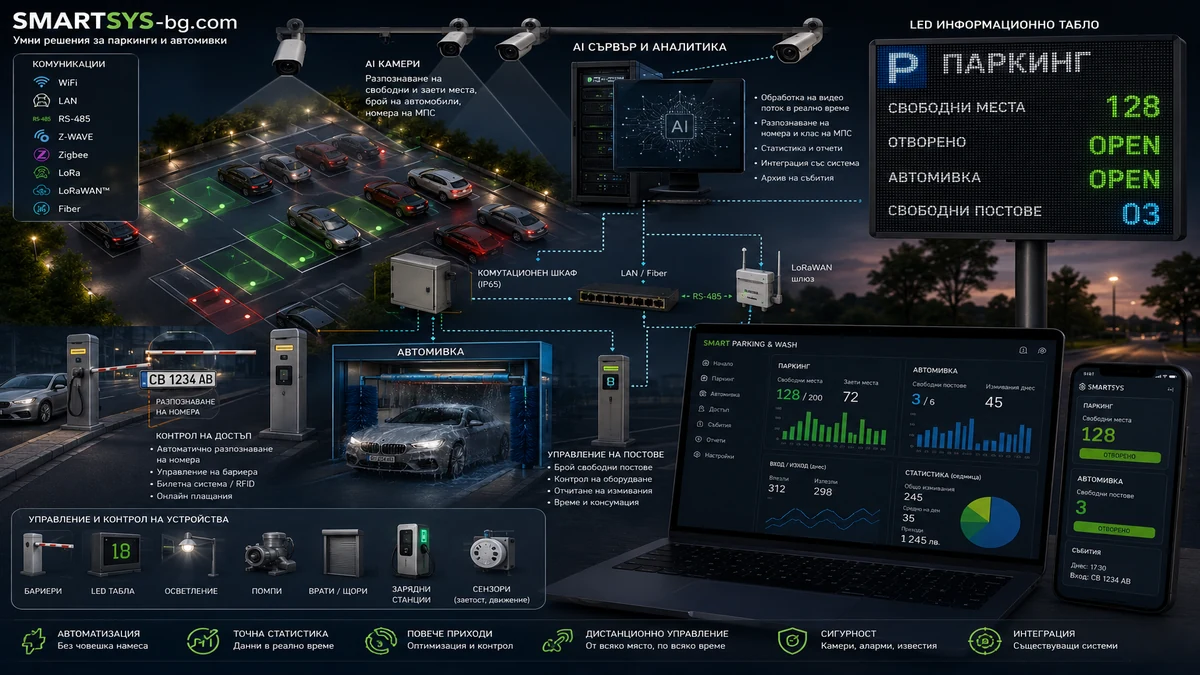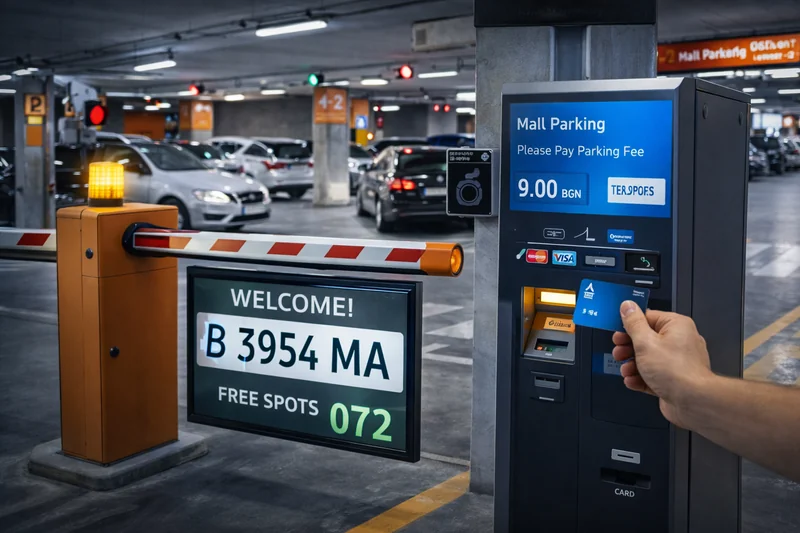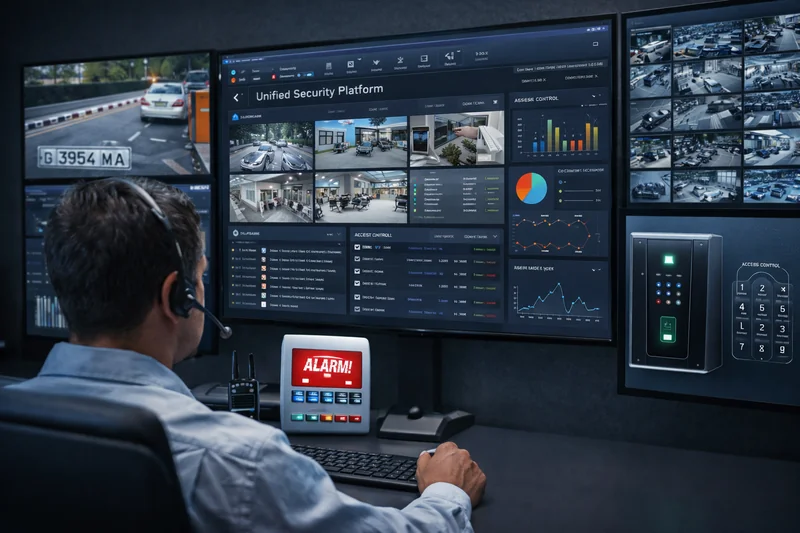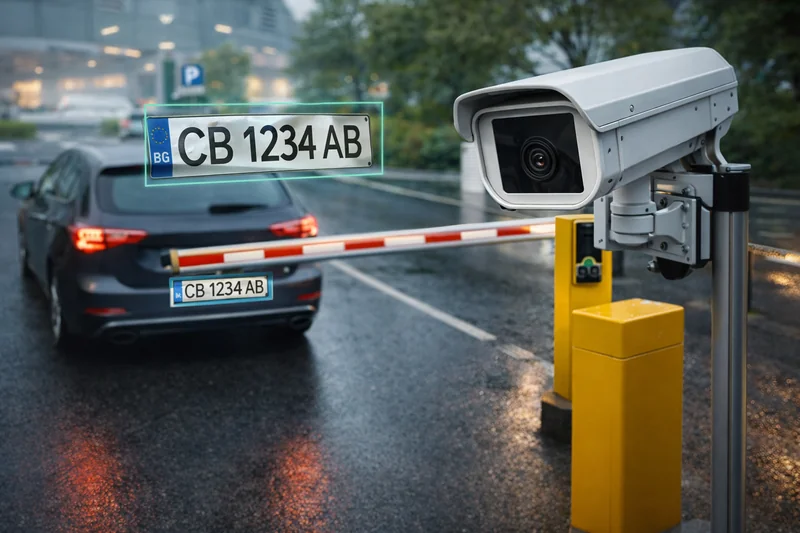
In a company or residential car park, the question of who is allowed in is usually handled with cards, tags or remote controls. These get lost, left in another car or lent to someone else. An automatic number plate recognition (ANPR) system removes that problem: the pass is the vehicle's own licence plate. The camera reads the plate of the approaching car, the software checks it against the permission list and sends a command to the barrier. The whole process takes less than a second, and the driver does not need to lower the window.
This article looks at how such a system works, what it consists of, what it should be able to do, and which planning mistakes lead to poor accuracy and inconvenience.
Where it makes sense
ANPR fits anywhere there is a stable group of users and outside vehicles need to be filtered out: company and residential car parks, logistics sites, hotels, retail and residential complexes. A common reason for installing it is also purely practical: outside vehicles parking for free on the premises and taking spaces meant for staff or residents.
How it works, step by step
- Detection. An induction loop in the road surface or a radar detects an approaching vehicle and triggers recognition.
- Capture. The ANPR camera captures the plate using infrared illumination, so recognition works at night and against oncoming headlights.
- Check. The software compares the plate with the permission list: permanent user, temporary access or blocked plate.
- Decision. On a match, the barrier opens automatically. For an unknown plate, the call can be routed to an intercom or confirmation can be requested from reception.
- Logging. The event is recorded with an image, plate number, direction, date and time.
- Closing. The barrier lowers only after the loop confirms that the vehicle has passed, so the arm does not strike the car.
What the system should be able to do
- High recognition accuracy. With correct camera positioning, manufacturers typically state over 98%.
- Automatic barrier opening for authorised plates.
- Reading Bulgarian and most European plate formats.
- IR illumination for operation by day, at night and in complete darkness.
- Lists of permanent, temporary and blocked plates.
- User groups and schedules, for example suppliers only on weekdays from 08:00 to 17:00.
- A web interface for management from a computer or phone, with nothing to install.
- A log of all passages with image, plate, direction, date and time.
- Occupancy and hourly traffic reports with export to Excel.
- Length-of-stay reports for car parks with time limits.
- Offline operation when the network is down.
- Backup opening by remote control, card or a button at reception.
- Protection against the barrier arm coming down on a vehicle.
What the system consists of
A typical configuration for a car park with a separate entry and exit includes:
- 2 ANPR cameras: one for the entry and one for the exit, with built-in IR illumination and a lens chosen for the distance to the plate.
- 2 automatic barriers: with an arm sized to the lane width and anti-crush protection.
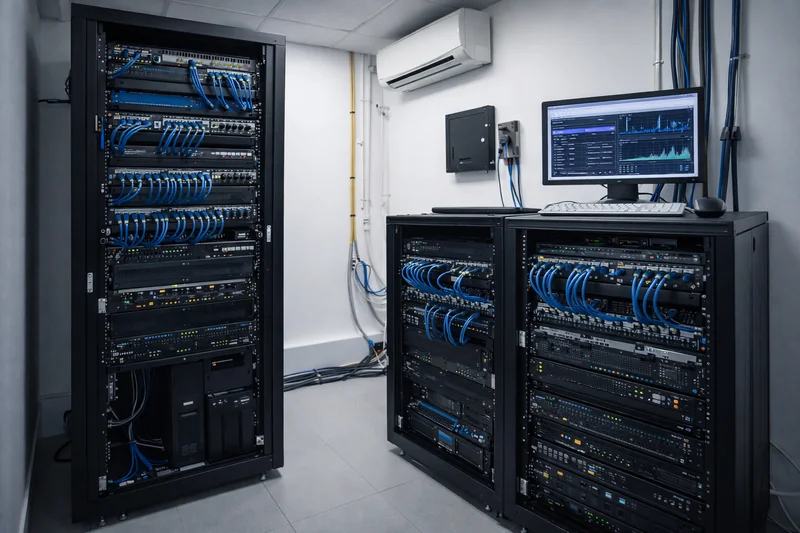
- A server or controller: stores the permission lists and the log and controls the barriers. It should hold a local copy of the list so it keeps working if the connection drops.
- Management and reporting software: a web panel for lists, schedules and reports.
- Induction loops and power supply: the loops are cut into the surface in front of and under the barrier and serve both to trigger recognition and to close the barrier safely.
- Installation, configuration and calibration: positioning the cameras relative to the vehicles' path, setting the recognition zone and testing in daylight and at night.
- Training for the people who will maintain the lists and work with the log.
Managing permissions and reports
The strength of ANPR lies not only in the barrier but in flexible access management. Permanent users are entered once. Guests and suppliers receive temporary access valid for a specific date and time window, which expires automatically. Blocked plates are refused, and a notification can be generated. Groups and schedules allow different rules: staff can enter at any time, the cleaning contractor only in the evening, and suppliers during working hours.
The log, with an image attached to every entry, provides a complete history of who passed, when and in which direction. Hourly reports show how busy the car park is and help with space planning, while length-of-stay reports are useful wherever parking is time-limited.
Technical parameters worth checking
| Parameter | Typical value |
|---|---|
| Recognition accuracy | over 98% with correct positioning |
| Plate formats | Bulgarian and most European |
| Speed in the recognition zone | up to about 30 km/h |
| Lighting | built-in IR illumination, works in complete darkness |
| Barrier | automatic, arm sized to the lane width, anti-crush protection |
| Offline operation | the controller continues with its local list |
| Backup entry | remote control, card or button at reception |
Advantages over cards and remote controls
- No lost or handed-over cards, because a licence plate cannot be lent out.
- Free-flowing traffic with no stopping or lowering of windows.
- A complete archive of all passages.
- No costs for issuing and replacing passes.
- Outside vehicles can no longer park on the premises for free.
Common planning mistakes
- A camera at too steep an angle. When the camera views the plate from far to the side or from high above, the characters are distorted and accuracy drops. The camera should be as close as possible to the direction of travel.
- No speed-reduction zone. If there is no bend, speed bump or sufficiently long straight section before the barrier, vehicles arrive too fast and the images blur.
- A barrier without a safety loop. Closing on a timer instead of a loop signal risks the arm coming down on a vehicle, especially one towing a trailer or two cars close behind each other.
- No backup way in. A dirty or damaged plate, a new car whose plate has not been entered yet, or temporary plates all require an alternative: remote control, card or a reception button.
- Dependence on the network. If decisions are made only on a remote server, every connection outage stops the car park.
- Unmaintained lists. The system is only as accurate as its data. It must be clear who adds and removes plates and how long the log is kept, since licence plates and images of drivers can constitute personal data.
Quick checklist
- Is there a straight section or a speed-reduction feature in front of the camera?
- Does the camera view the plate close to the direction of travel and at the right distance?
- Is barrier closing controlled by a loop?
- Is there a backup way to open the barrier?
- Does the controller work from a local list when the network is down?
- Have groups, schedules and the person responsible for the lists been defined?
- Has a retention period for the log and images been set?
A well-positioned ANPR system practically disappears from users' daily routine: the barrier rises before the driver has stopped, and the administrator has an accurate, verifiable record of every passage.