Why holiday homes are a preferred target
Holiday homes and houses outside town stand empty for much of the year. Neighbours are far away, nobody notices a light or an open window, and the owner often learns about a break-in weeks later. That is exactly what makes such properties attractive — an intruder counts on time and on the absence of witnesses.
An alarm system for a holiday home takes that advantage away. It has to detect the attempt to get in, make noise on site and notify the owner within seconds, whether they are in the next village or hundreds of kilometres away. This article looks at how such a self-monitored system is planned, what it consists of and which mistakes most often make it unreliable.
Two scenarios the system must cover
Well-designed protection works in two layers.
- Perimeter of openings. Magnetic contacts on entrance doors and accessible windows trigger the moment they are opened — before the intruder is even inside.
- Interior volume. Passive infrared (PIR) detectors in hallways and main rooms pick up movement if the perimeter has been bypassed — for example through broken glass without opening the sash.
The two layers complement each other: the perimeter gives early warning, while interior protection is the fallback when the first layer is circumvented. Assigning them to separate zones also allows partial arming — only the perimeter while the family is asleep inside.
What the system should be able to do
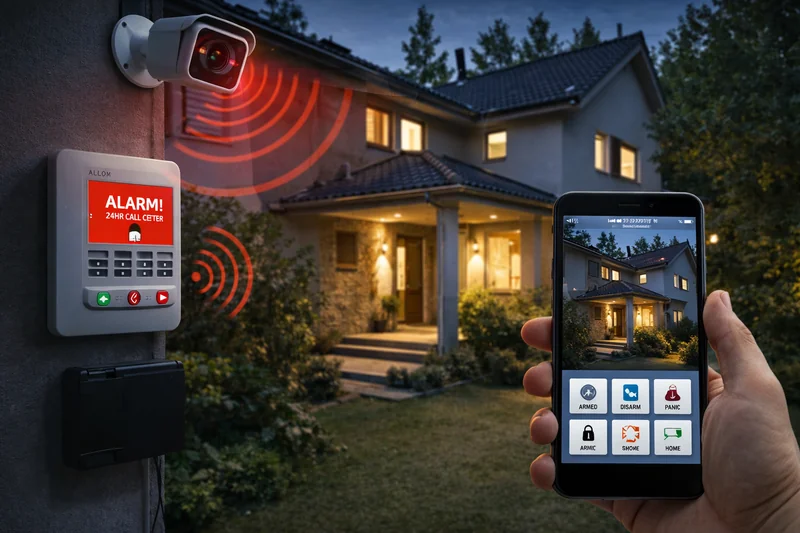
- GSM notification — voice call, SMS and push notification in the mobile app
- Alarm video verification — a snapshot from the site attached to the notification
- Arming and disarming from the app, a keypad or a key fob
- Partial arming by zone (night mode)
- Pet-immune detectors
- Tamper protection on all devices, including the siren
- Operation during power cuts thanks to a backup battery
- Alerts on mains failure, lost GSM connection and low battery
- Silent panic button — a signal without sounding the siren
- Event log: who armed and disarmed the system and when
- Expandability with smoke detectors, flood sensors and garage door contacts
What it consists of
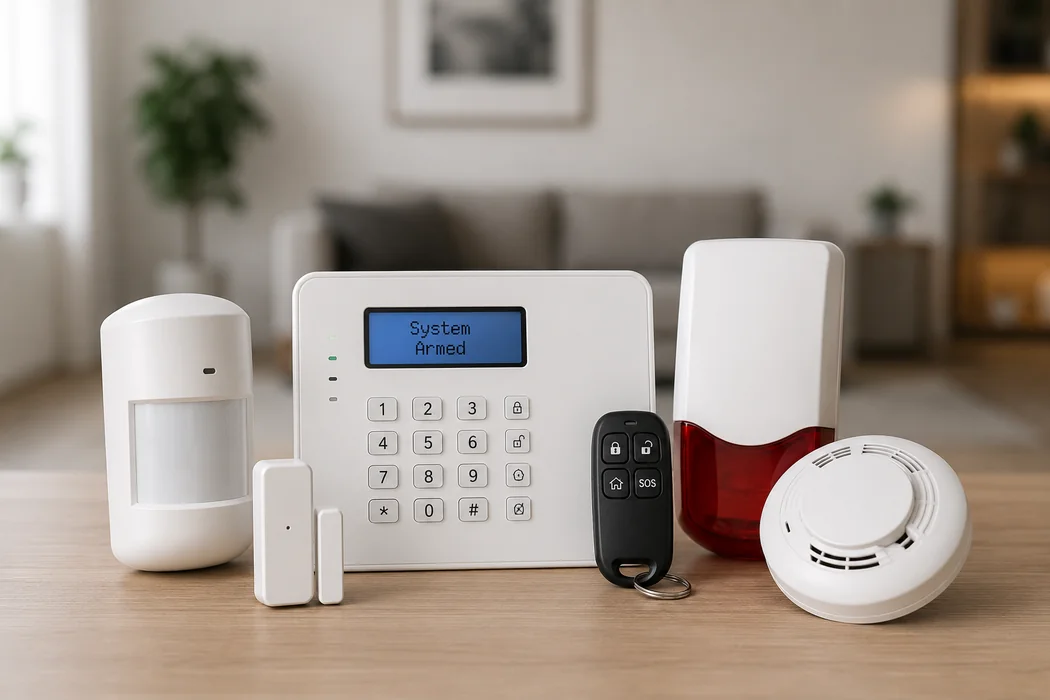
For a typical holiday home or family house on one or two floors, the set looks roughly like this:
- Alarm control panel — with an expandable number of zones and support for wired and wireless peripherals
- 6 PIR detectors — pet-immune, with a range of about 12 m
- 4 magnetic contacts — for the entrance doors and the most accessible windows
- Outdoor siren — with its own battery and a tamper switch against opening the housing
- GSM module — with its own SIM card; optionally a backup channel over the internet
- Backup power supply — a battery that keeps the panel running during a power cut
- Video verification camera — linked to the alarm zones
The number of detectors and contacts depends on the layout. Every entrance and every window reachable from the ground, a terrace or the roof of an outbuilding is a potential entry point and has to be taken into account.
Video verification: why it is the key element
A conventional alarm only reports that “something has been triggered”. For an owner two hours away, that is a hard call: drive out, ask a neighbour, or ignore the signal. Video verification changes this — the notification arrives together with a snapshot of the zone where the detector was triggered.
Within seconds it becomes clear whether this is a real intrusion attempt, a cat that came in through a window left ajar, or a fallen object. False alarms are filtered out and pointless trips to the property are avoided. In a real incident, the image is also useful information for the police.
Wired or wireless installation
In new builds or major renovations, a wired system is preferable: detectors are powered from the panel, there are no batteries to replace, and the link cannot be jammed over the radio. Cables are laid before plastering, with some spare length left at every device.
In a finished interior, wireless peripherals allow installation without chasing walls. Modern wireless detectors use two-way encrypted communication and report low battery and lost connection. A mixed approach is common — the panel and siren are wired, while hard-to-reach windows are covered with wireless contacts.
Self-monitoring in practice
The system described here is self-monitored. The notification goes directly to the owner rather than to a monitoring centre, and the owner decides what to do — review the images, ask a neighbour to check or call 112. Notifications therefore have to arrive reliably: it is wise to have at least two people on the notification list and to make sure the phone does not silence the app.
The siren and visible stickers on the facade have value of their own — they are a strong deterrent and often make an intruder look for another property. Some insurers also take an alarm system into account when setting policy terms.
Common planning mistakes
- PIR detector facing a window, fireplace or air conditioner. Sunlight and rapid temperature changes cause false alarms. The detector should point into the room, not at heat sources.
- Overestimated pet immunity. It works for an animal moving on the floor; a cat jumping onto furniture at the height of the detector can still trigger the alarm.
- Unchecked GSM coverage. Signal is often weak in holiday home areas. It should be measured at the panel location before installation, with an external antenna used if needed.
- Prepaid SIM card left unmonitored. Expired credit or a deactivated card means a silent system. A periodic test message from the panel is a useful safeguard.
- Siren within reach. The outdoor siren is mounted high, out of reach of hands and ladders, with the tamper switch enabled.
- Secondary entrances left uncovered. Basements, garages, attics and windows facing a terrace are often left out of the system.
- A battery nobody checks. In an unheated house in winter, battery capacity drops. The battery should be tested at least once a year and replaced every few years.
- A camera that films someone else's property. The verification camera should cover the owner's own premises, not the street or the neighbour's yard.
Quick checklist
- All doors and accessible windows have magnetic contacts.
- Hallways and main rooms are covered by correctly aimed PIR detectors.
- Perimeter and interior are in separate zones, and night mode is configured.
- GSM coverage has been checked and the SIM card is active.
- At least two people receive notifications.
- Key zones have video verification.
- The system, siren and battery are tested before every longer period without occupants.