Purpose and roles
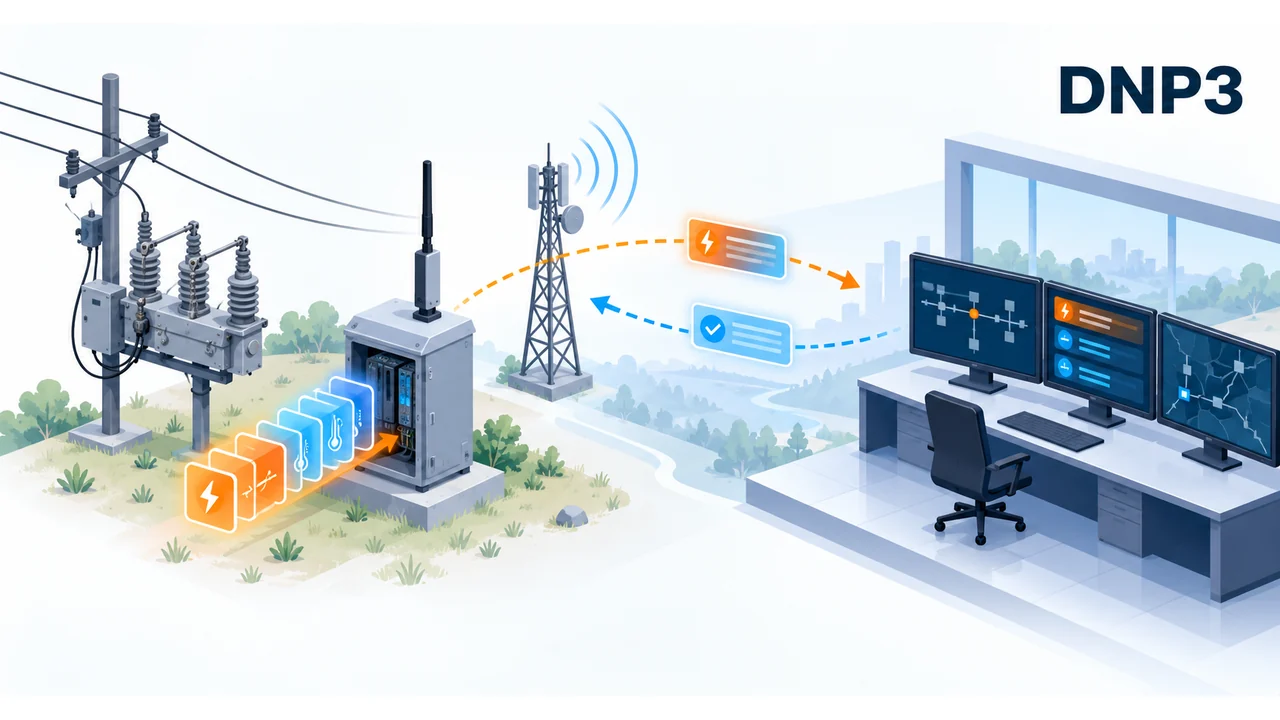
DNP3 was developed by Westronic in the early 1990s and became IEEE 1815. It is widely used in North America and other regions for power, water and industrial telemetry. A master requests data and issues commands; an outstation collects field data and responds. Supported unsolicited responses allow event reporting without a preceding poll.
Serial RS-232/RS-485 and IP mappings are common; TCP commonly uses port 20000. UDP support does not mean application data may simply be discarded: protocol confirmations and retry rules still apply.
Layers and object model
The link layer frames messages and applies CRC checks to data blocks. A pseudo-transport layer segments and reassembles longer messages. The application layer defines object groups, variations and functions such as Read, Select, Operate and Freeze.
Examples include Group 1 binary input status, Group 2 binary input events, Group 10 binary output status, Group 12 CROB control, Group 20 counters, Group 30 analogue inputs, Group 32 analogue events and Group 40 analogue output status. Group 10 is status rather than a control command. Supported variations determine coding, flags and timestamps; variation 0 can allow a supported default choice, not arbitrary substitution.
Static data and events
Class 0 requests configured static data. Classes 1–3 organise events; systems often service Class 1 first, but classes do not impose universal importance on every point. An initial integrity poll commonly requests event classes and Class 0, not Class 0 alone.
Outstations buffer events within finite capacity. Timestamp presence depends on variation. Unsolicited event responses require application confirmation where specified and can be retried. Deadbands and reporting settings control event volume; buffering does not guarantee against overflow.
Commands and security
Select-before-operate separates selection and operation. Direct Operate is also available where supported. CROB contains the control code, count and on/off timing; device capabilities, interlocks and operational rules remain decisive.
Secure Authentication v5 authenticates selected critical operations and protects integrity. It is not automatically present or enabled in every DNP3 product. Challenge-response and aggressive mode have different exchange overhead. Key management and algorithms must match the profile. SAv5 does not encrypt all data; confidentiality may require supported TLS or a protected tunnel.
Engineering and diagnosis
Agree link addresses, object groups, variations, indices, class assignments, deadbands and buffer sizes. Test initial integrity, event polling, unsolicited confirmations, commands and restart behaviour. A protocol analyser helps distinguish unsupported variations, CRC faults and timeouts.
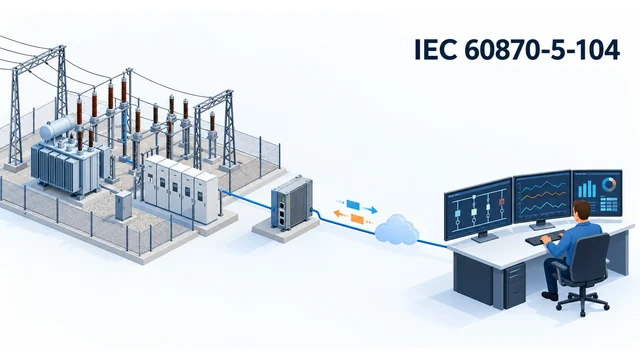
DNP3 and IEC 104 can solve similar telecontrol tasks. Geography is a deployment pattern, not a technical boundary. Choose by operator requirements, supported functions, event handling and security rather than assuming one protocol universally replaces another.