Architecture and model
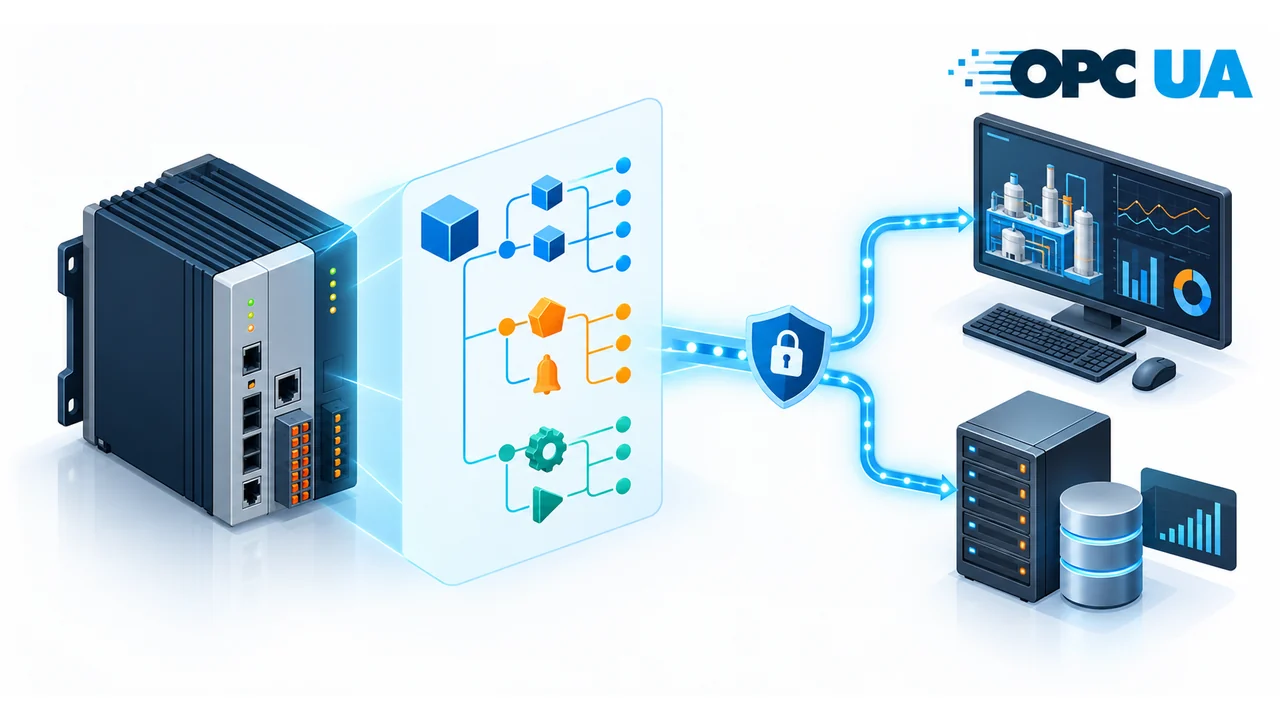
OPC UA is the platform-independent IEC 62541 family developed by OPC Foundation. It brings live data, history, events and methods into an extensible model, replacing the Windows/DCOM dependency of OPC Classic where appropriate.
The Address Space is a graph of nodes and references, not simply a tree. NodeId includes a namespace and a numeric, string, GUID or ByteString identifier. BrowseName, DisplayName and NodeClass describe nodes. Variables can supply values, timestamps and StatusCode. Types describe reusable structures, but discovery does not automatically supply all application semantics.
Companion models
Companion Specifications define domain-specific models such as Machinery and ISA-95, with work mapping IEC 61850 data into OPC UA. Check each specification's status and revision. CIM standards IEC 61968/61970 must not be presented as one universally finished OPC UA for Energy specification.
Shared models improve interoperability but do not eliminate configuration: namespaces, versions, profiles, optional functions and permissions still matter.
Client-server and transport
A client discovers or configures an endpoint, establishes the applicable channel and session, browses nodes and uses Read, Write, Call or subscriptions with MonitoredItems. Discovery services are available where deployed; they are not compulsory universal infrastructure.
The common opc.tcp mapping uses UA TCP and UA Secure Conversation, not TLS 1.2/1.3. Port 4840 is a common default, not the only possible endpoint port. HTTPS/TLS and WebSocket mappings depend on version and support.
PubSub
PubSub distributes datasets without a permanent client-server session between every publisher and subscriber. UADP over UDP multicast and supported MQTT/broker mappings are examples. Encoding, transport and security must be matched; every product does not implement every combination. UDP multicast does not by itself guarantee TSN or deterministic latency.
Security
Application identity, user identity and authorisation are distinct. opc.tcp uses the negotiated SecurityPolicy and None, Sign or SignAndEncrypt mode through UA Secure Conversation. HTTPS uses TLS for its transport mapping. Anonymous access need not permit writes, and authenticated users should not automatically get all rights.
Validate certificate trust, expiry and revocation as applicable; select a supported contemporary policy and suitable protection mode. Control exposed endpoints, minimise permissions, maintain audit records and segment networks. PubSub message security and transport security are separate; a client-server certificate does not automatically protect every PubSub flow.
Energy integration and recovery
OPC UA can connect SCADA, DCS, historians and MES, or expose substation data through a gateway while preserving meaning. Reporting intervals and timestamps must match the application's requirements, rather than implying universal real-time performance.
After interruption, first assess reactivating the existing session. TransferSubscriptions is a separate supported operation with permissions; otherwise subscriptions may need recreation. Common problems include certificate trust, blocked endpoints, excessive MonitoredItems and incompatible model versions. OPC UA complements rather than universally replaces field telecontrol protocols.