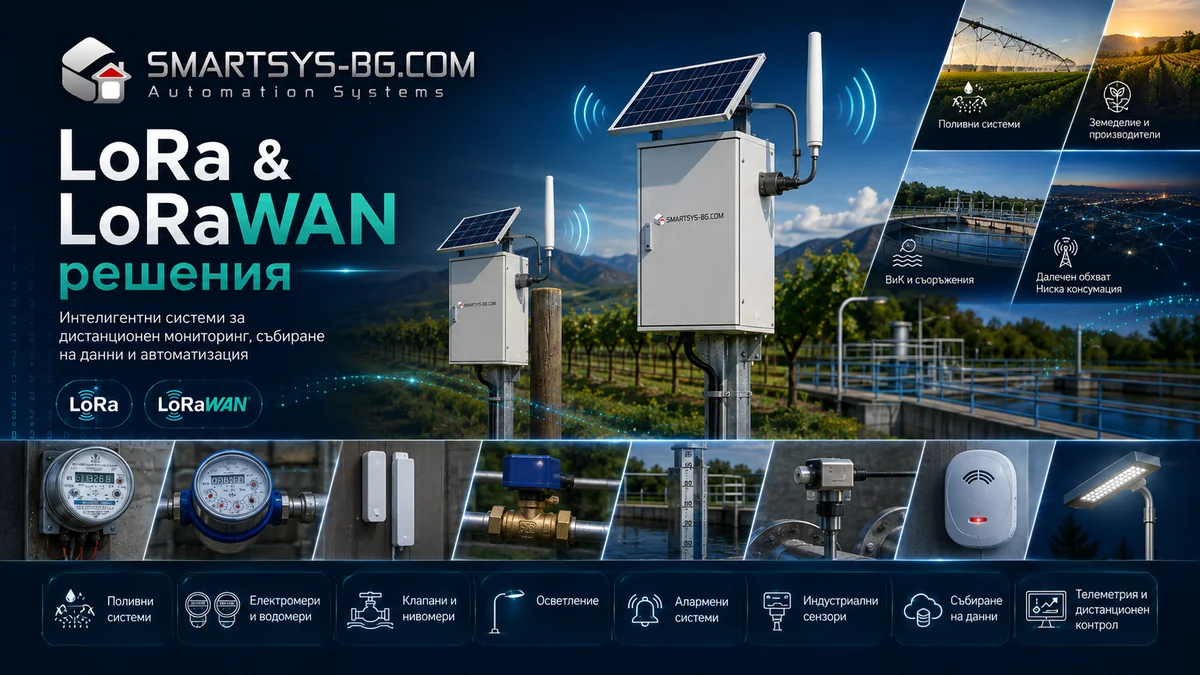
LoRa is a radio technology for transmitting small amounts of data over long distances with very low power consumption. LoRaWAN is the network protocol built on top of it: it defines how sensors connect to a base station and how data reaches a server. In Europe it operates in the licence-free 868 MHz band, so it requires neither a licence nor a mobile operator subscription.
How it works
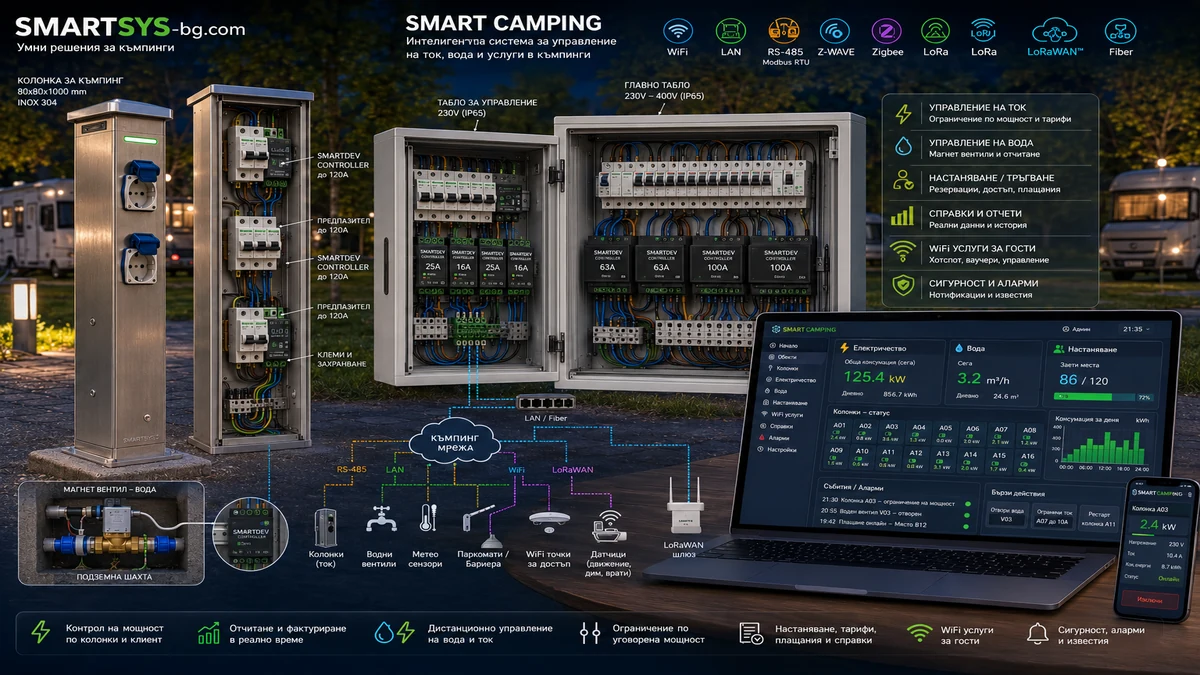
Devices do not connect to one another; each one talks directly to a base station (gateway). The gateway forwards packets to a network server, which passes them on to the application — a dashboard, a database or a control system. The topology is a star, which keeps sensors simple and energy-efficient.
Range is several kilometres in urban areas and over 10 km with clear line of sight. A battery-powered sensor lasts between 3 and 10 years, depending on how often it transmits. The trade-off is speed: LoRaWAN carries tens of bytes per message, a few times an hour — enough to report a measurement, but not enough for video or audio.
Why it suits water facilities
Water infrastructure is usually spread over a large area — reservoirs, manholes, pumping stations, irrigated fields. Many of these sites have no power supply nearby and no wired network coverage. Running a cable to every point is expensive and sometimes impossible. With LoRaWAN, a single gateway covers an entire site or neighbourhood, while the sensors run on batteries for years.
What can be monitored and controlled
- Water level — tanks, ponds, manholes. Early warning of overflow or depletion.
- Pipeline pressure — detecting drops that indicate a leak or a blockage.
- Consumption — remote reading of water and electricity meters without visiting the site.
- Water quality — temperature, turbidity, pH, conductivity.
- Soil moisture — the basis for irrigating according to actual need rather than a fixed schedule.
- Pump condition — operating hours, vibration, alarm signals.
- Valves and pumps — LoRaWAN also supports downlink traffic, so commands can be sent remotely, albeit with some delay.
The same network can do other jobs
Once installed, a gateway serves any sensor within its range, not only water-related ones. In practice it is also used for metering energy use in buildings, monitoring temperature in warehouses and cold rooms, counting passages, reading levels in silos and fuel tanks, and controlling street lighting. Expanding the system means adding a device, not building a new installation.
What LoRaWAN does not solve
The technology is not universal and has clear limits:
- It is not meant for large volumes of data. Video surveillance, images and streaming data require a different network.
- It is not real-time. Messages are sent periodically; delays of seconds to minutes are normal.
- It does not replace SCADA where guaranteed control is required. For critical processes it serves as a supplement, not as the only channel.
- Range depends on the terrain. Dense urban development, metal structures and underground chambers reduce it considerably — which is why a site survey and on-site test measurements are essential before deployment.
What is needed to get started
The minimum setup is a gateway, a few sensors and a network server. The server can be self-hosted or used as a service. If there is a single site with only a few measuring points, one gateway is usually enough; for dispersed infrastructure, coverage is planned just as for any radio network.