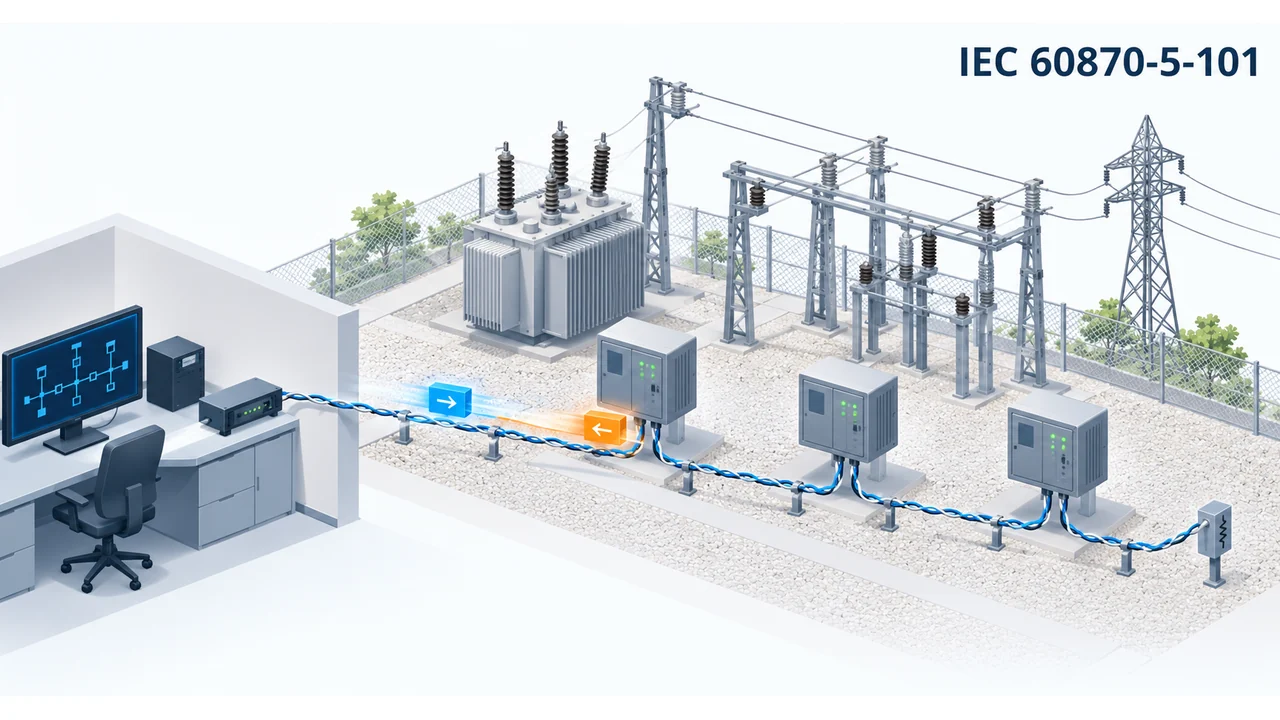
Purpose and layers
IEC 60870-5-101 defines a telecontrol profile for serial links used by RTUs and control centres. IEC 60870-5 parts 1–5 cover frame formats, link procedures, application-data structure, coding and basic application functions. IEC 101 selects and specifies their use. RS-232 and RS-485 are physical interfaces, not electrical standards defined by IEC 60870-5-1.
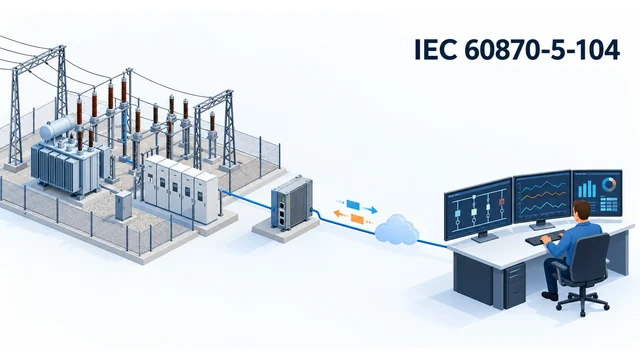
IEC 101 and IEC 104 share many services and objects, but their profiles and field sizes differ. Encapsulating a serial stream in an IP modem does not turn it into IEC 104.
Physical links
RS-232 commonly provides point-to-point links; RS-485 supports suitable multidrop arrangements. Radio, optical and cellular serial modems are also possible. Baud rate, parity, turn-around time and framing must match. Distance and node loading follow the interface, cable and transceivers; 32 unit loads and approximately 1200 m at low rates are not universal IEC 101 limits. Check availability of legacy cellular technologies in the relevant region.
Balanced and unbalanced exchange
In unbalanced operation the controlling station initiates link exchanges and controlled stations respond to polling. An RTU can collect spontaneous events internally, but sends them over the unbalanced link in response to a request. Balanced operation permits either side to initiate supported point-to-point exchanges.
FT1.2 has fixed and variable-length frames, plus the E5h acknowledgement where applicable. A fixed frame is five bytes only with a one-byte link address; link-address length depends on profile and mode. A variable frame starts 68h, L, L, 68h. The error check is an eight-bit arithmetic checksum, not CRC. FCB/FCV and function codes support the applicable link procedures.
Classes and application objects
Class 1 is commonly used for higher-priority event data; Class 2 for lower-priority/background data. Polling and ACD help the master retrieve waiting data. Application ASDUs contain Type ID, VSQ, Cause of Transmission, Common Address and information object addresses. Configurable sizes must agree; IEC 104 fixes several sizes that IEC 101 can vary.
The available status, measurement, counter and command types resemble IEC 104, but supported type IDs must be verified. General and counter interrogation, clock synchronisation, select-before-operate and direct execute depend on the profile.
Time and operational checks
CP24Time2a has three bytes with minute and milliseconds within the minute, not a complete date/hour. CP56Time2a has seven bytes for a fuller timestamp. Resolution must not be confused with actual clock accuracy. Serial devices may synchronise through protocol commands or another supported source; absence of NTP alone does not prove an unsynchronised clock.
Test polling cycles, addresses, data classes, commands, time and recovery using suitable serial capture or analysis tools. Frequent faults include mismatched parity, duplicate addresses, RS-485 collisions, insufficient turn-around delay and slow polling.
Use and security
IEC 101 remains useful for existing serial infrastructure and compatible radio/modem links. Where IP infrastructure is available, IEC 104 can be convenient, but operator and equipment requirements decide. The base serial protocol has no cryptographic protection; physical access, modem/gateway security, access restrictions and supported security extensions remain relevant.