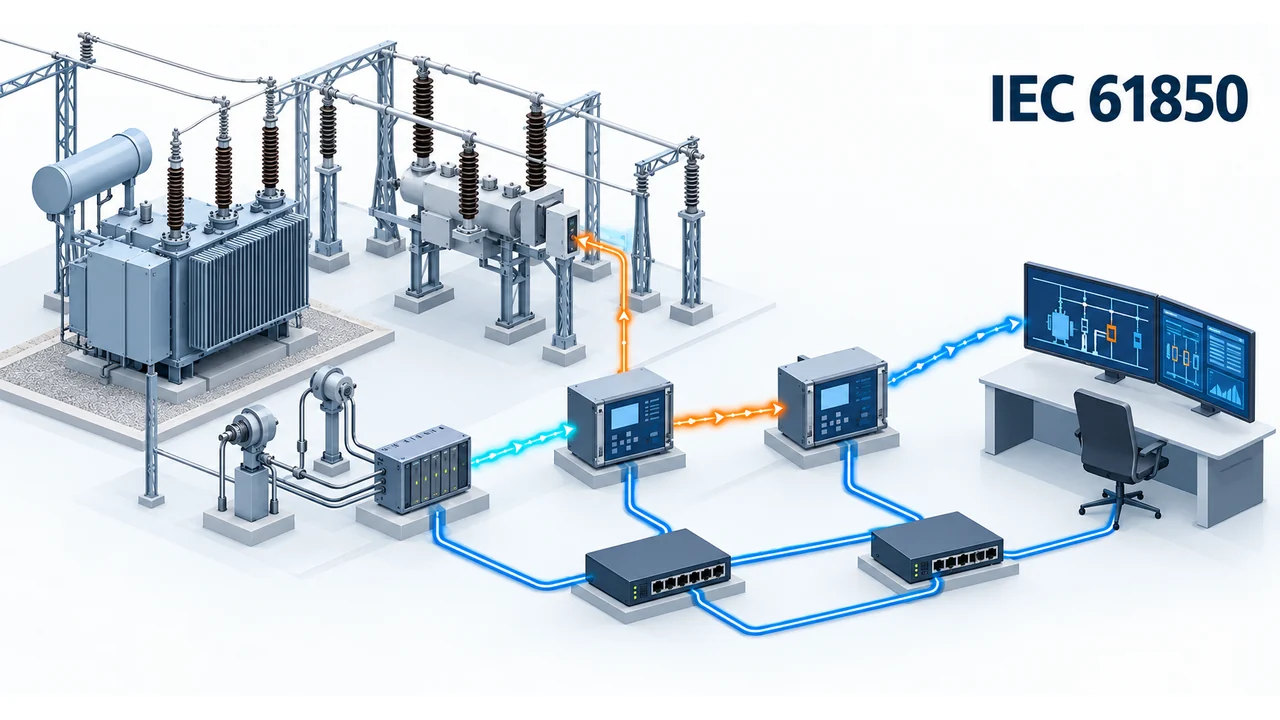
A family of standards
IEC 61850 is a family for power-utility automation communication and information modelling, not just one packet protocol. It models IED functions and data and defines services and mappings. Applications extend beyond one voltage level or only horizontal substation communication.
MMS, GOOSE and Sampled Values
MMS supports client-server access to values, reports, logs and control. Typical mappings use TCP/IP. GOOSE provides publish-subscribe event exchange such as interlocking; Sampled Values streams digitised measurements. Conventional GOOSE/SV use Ethernet Layer 2 multicast.
Performance requirements depend on function and class. The fastest protection applications can require transfer times around 3 ms; enabling GOOSE alone guarantees no universal latency. The complete communication chain must meet the requirement.
Models and SCL
A physical IED exposes Logical Devices, Logical Nodes, Data Objects and Data Attributes, for example XCBR.Pos and stVal/q/t. Standardised semantics improve interoperability, but supported services, editions and tools still need agreement.
IEC 61850-6 defines the XML configuration-description language commonly called SCL. SSD describes system requirements, ICD IED capabilities, SCD the system configuration and CID a configured IED description. Files support engineering; they do not eliminate address, DataSet or service configuration.
Reports, control and events
MMS can deliver buffered or unbuffered reports and logs. Control models include direct and select-before-operate with normal or enhanced security. In this terminology enhanced security concerns command procedure and feedback, not encryption.
GOOSE is a separate multicast mechanism, not a subscription transported through MMS. stNum changes with state; sqNum identifies retransmissions; timeAllowedToLive helps detect loss. Repetition improves resilience but is not an absolute delivery guarantee. VLAN, priority, multicast filtering and QoS must be engineered together.
Sampling, clocks and networks
9-2LE is a UCA International Users Group implementation guideline based on IEC 61850-9-2, not a separate IEC edition. Familiar rates are 80 or 256 samples per period, giving 4000 or 12800 samples/s at 50 Hz, with four current and four voltage values. Other profiles, including IEC 61869-9, have different requirements.
Clock synchronisation may use supported PTP profiles or other mechanisms; 9-2LE does not automatically mean mandatory PTP. Station and process buses are functional divisions that may use separate or shared infrastructure. PRP duplicates across two LANs; HSR uses redundant ring paths. Neither is compulsory in every installation, and RSTP recovery must be assessed against tolerated interruption.
Editions, security and integration
Individual parts have their own editions and amendments. IEC 61850-7-420 addresses distributed resources; IEC 61400-25 concerns wind-power models; 90-5 describes routable exchanges. Check the exact supported part and version.
IEC 62351-3/-4 are relevant to protected MMS profiles; part 6 provides IEC 61850-specific security including GOOSE/SV. TLS is not simply wrapped around ordinary Layer 2 multicast frames. Access control, keys, certificates and network architecture matter. Gateways can map supported IEC 61850 data to IEC 104 while preserving quality, time and control semantics.