What KNX is
KNX is an open standard for building automation: lighting, blinds, heating, air conditioning, scenes, metering. It is described in ISO/IEC 14543-3 and the European standard EN 50090. It appeared in 1999 as a merger of three older systems: EIB, BatiBUS and EHS. It is maintained by the KNX Association, and devices from different makers work together.
A decentralised system
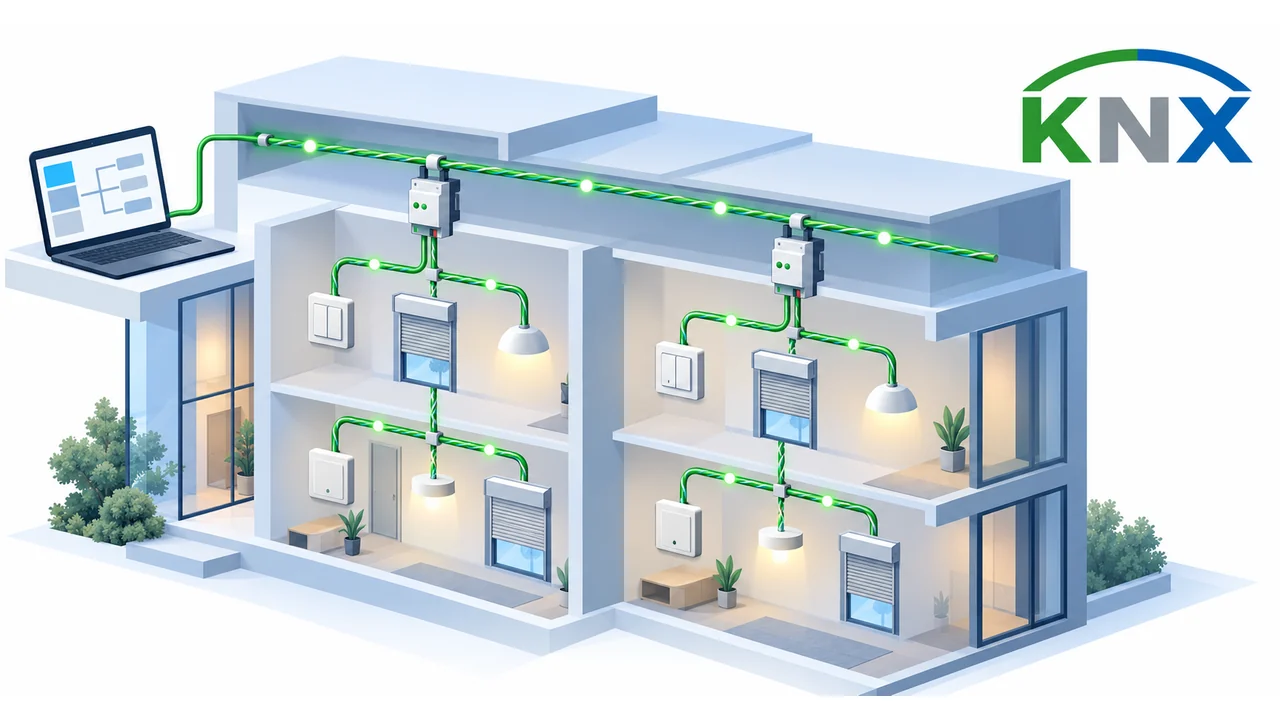
KNX has no master controller without which the system stops. Every device (switch, actuator, sensor) has its own microcontroller and knows whom to talk to. If one module fails, the rest keep working. A central server or visualisation can be added but is not mandatory.
Transmission media
| Medium | How it transmits | Note |
|---|---|---|
| KNX TP | Twisted pair | Most common. The bus also carries power (about 29 V DC), speed 9600 bit/s |
| KNX PL | Over 230 V mains | For sites where a new cable cannot be run |
| KNX RF | Radio, 868 MHz | For extending an existing installation |
| KNX IP | Over Ethernet | Links between lines and to supervision systems |
Topology
The installation is a tree of lines and areas. A line is a cable segment with a limited number of devices (up to 64 per segment, with repeaters for more). Lines connect to a main line through line couplers and areas through area couplers. Couplers filter traffic so messages on one line do not load the others.
Addresses
- Physical address — identifies the device: area.line.device, for example 1.1.15.
- Group address — identifies the function being addressed, such as "living room light". Usually written in three levels: main group/middle group/subgroup (for example 1/2/3).
A switch and a lamp are linked by giving them the same group address. One device can take part in many groups.
Telegrams and data types
Every command is a short telegram to a group address. Values follow standard Datapoint Types: 1 bit on/off, 4 bit dimming, 1 byte percentage, 2 byte temperature, and so on. This is how devices from different makers understand each other.
ETS
Devices are programmed with the ETS (Engineering Tool Software) tool. It sets physical and group addresses, device parameters and the links between them. The project is saved to a file and downloaded over the bus or an IP interface. Without ETS the installation cannot be configured.
When KNX is chosen
- Large and medium buildings with many functions.
- Sites that need interchangeability between makers.
- Long-lived systems that will be extended.
The drawbacks are the separate bus cable and the need to reconfigure with ETS after every change.