What Thread is
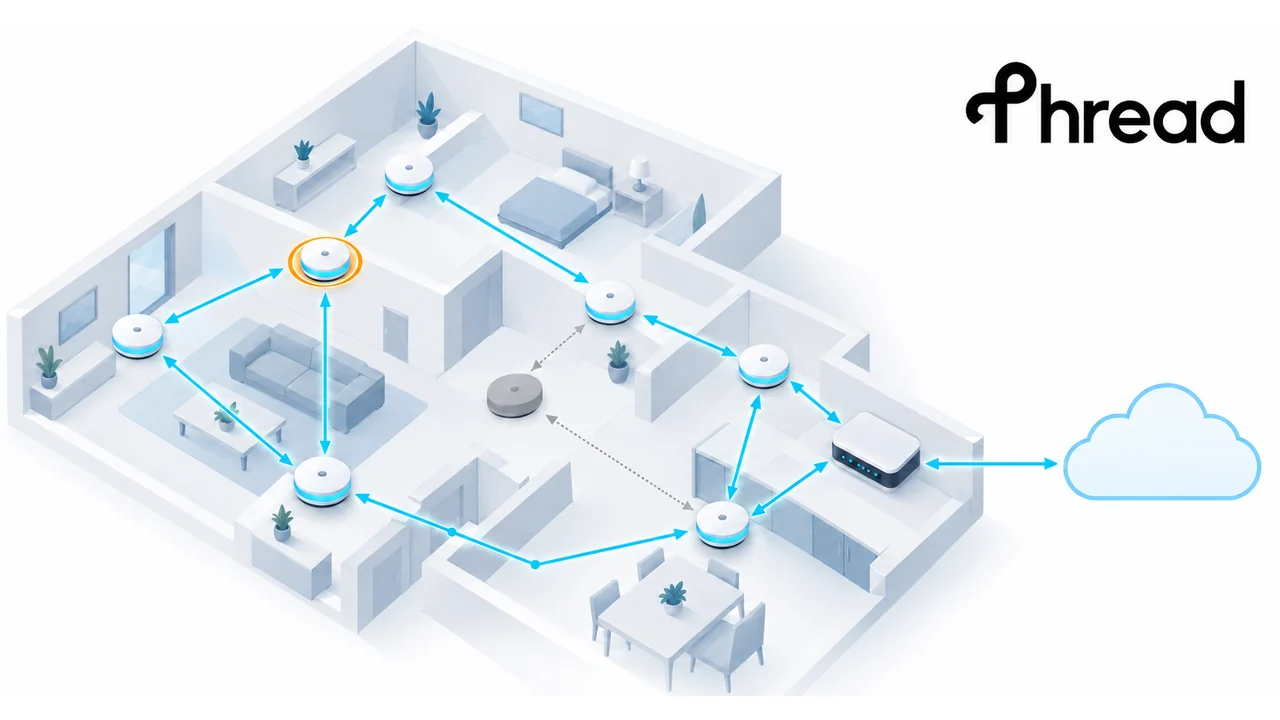
Thread is a network protocol for small, low-power devices. It uses the same radio as Zigbee (IEEE 802.15.4, 2.4 GHz) but carries plain IPv6 over it through 6LoWPAN. Every device has its own IP address and can be reached like any other network node.
What Thread is not
Thread is only transport. It does not say whether a device is a lamp or a thermostat. That is the job of an application layer such as Matter.
Node roles
- Router — forwards packets and takes part in mesh routing.
- REED — an end device that can become a router if the network needs one.
- End Device — only sends and receives through its parent.
- Sleepy End Device — sleeps and wakes rarely, for battery sensors.
- Leader — a router that keeps the network-wide information. If it disappears, another router takes over automatically.
Border router
A border router connects the Thread network to Wi-Fi or Ethernet, so devices can be reached from a phone or the cloud. There can be several, so there is no single point of failure. It is often built into smart speakers, hubs and some routers.
Comparison with Zigbee
| Zigbee | Thread | |
|---|---|---|
| Radio | 802.15.4 | 802.15.4 |
| Addressing | Own scheme | IPv6 |
| Central node | Coordinator | None, a leader is elected |
| Application layer | Zigbee clusters | Matter and others |
Security
The network is encrypted with AES-128, and joining a new device requires a passphrase supplied by the user or by the Matter commissioning process.
OpenThread
OpenThread is an open-source Thread implementation used in the ESP32-C6 and ESP32-H2 chips and many others. It also lets you build your own border router.
Practical notes
- Several mains-powered Thread devices are needed for a good mesh.
- Two different Thread networks in one home do not merge automatically.
- Channels and Wi-Fi interference matter just as with Zigbee.