What Z-Wave is
Z-Wave is a wireless smart home protocol designed for small commands and low power. It is supported by the Z-Wave Alliance, and the chips are made by Silicon Labs. Unlike Zigbee and Thread, it works at a frequency below 1 GHz, not 2.4 GHz.
Frequency
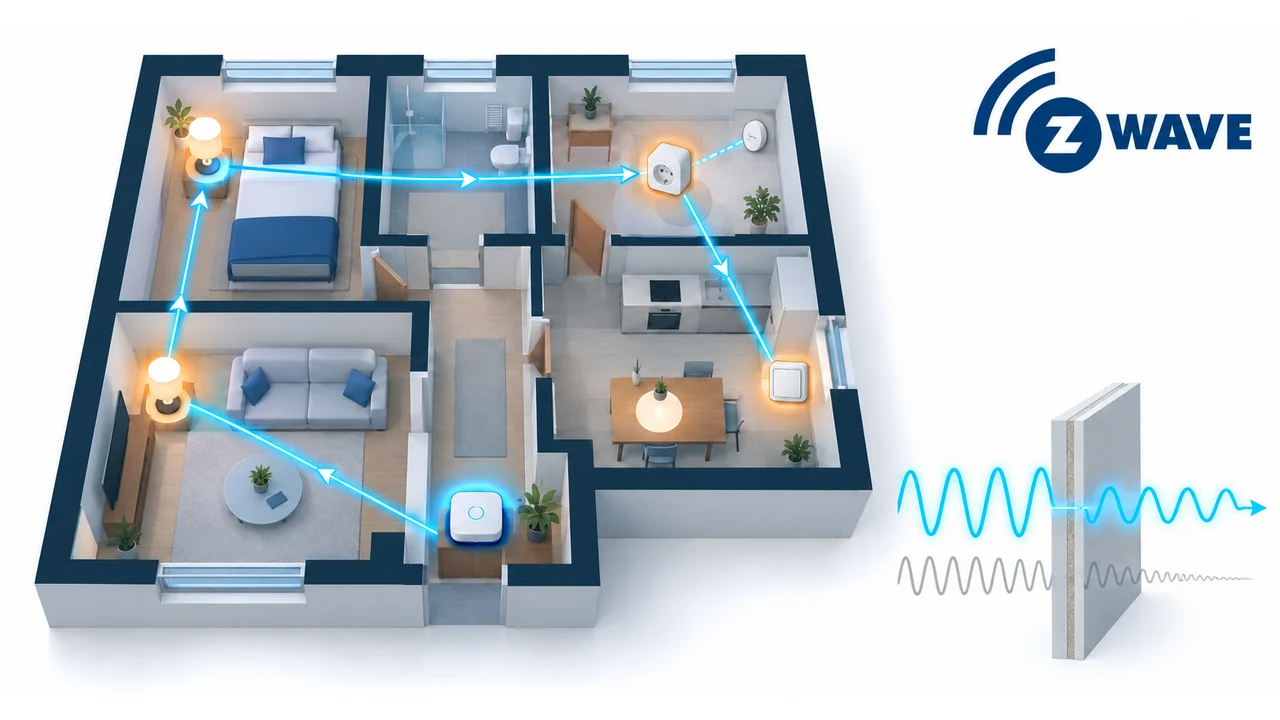
In Europe Z-Wave uses 868.42 MHz, in the US about 908.42 MHz. The band is much quieter than 2.4 GHz, where Wi-Fi, Bluetooth and microwave ovens compete. Lower-frequency radio passes through walls better. The drawback: devices from different regions are not compatible with each other.
Speed
9.6, 40 and 100 kbit/s. Enough for commands and readings, not for data streams.
Network
- Controller — creates the network and manages adding devices. There is a primary controller and secondary ones.
- Nodes — the devices. Mains-powered ones relay other nodes' packets.
- Home ID — a 32-bit network identifier.
- Node ID — an 8-bit node number within it.
One network holds up to 232 nodes. Packets pass through up to 4 intermediate nodes (hops). The controller knows the path and stores it as a route. If a node drops out, the route is found again.
Security
Modern devices use S2. Keys are exchanged on inclusion, with the user entering a PIN from the device or scanning a QR code. Communication is encrypted. Older devices support only weaker schemes and are not in the S2 levels.
Z-Wave Long Range
An extension where devices connect directly to the controller with no intermediate nodes. Range is considerably larger and the network holds thousands of nodes (up to 4000). It can coexist with standard Z-Wave.
Things to know
- All devices are checked against the specification for compatibility, so they interoperate well.
- Enough mains-powered nodes are needed for a good mesh.
- After moving a device, routing needs to be refreshed.
- The controller is key: without a backup the network is hard to restore.
Comparison with Zigbee
| Z-Wave | Zigbee | |
|---|---|---|
| Frequency | 868 MHz (EU) | 2.4 GHz |
| Speed | up to 100 kbit/s | up to 250 kbit/s |
| Network size | up to 232 nodes | hundreds to thousands, depending on implementation |
| Wi-Fi interference | none | possible |