A quarry in the mountains, a construction site, a farm, a mountain hut, a telecom tower — there are places the power grid does not reach, or where a grid connection costs more than the site itself. The classic answer is a diesel generator running around the clock. A microgrid is the smarter answer: several sources and an energy store working together under one controller.
What an off-grid microgrid is
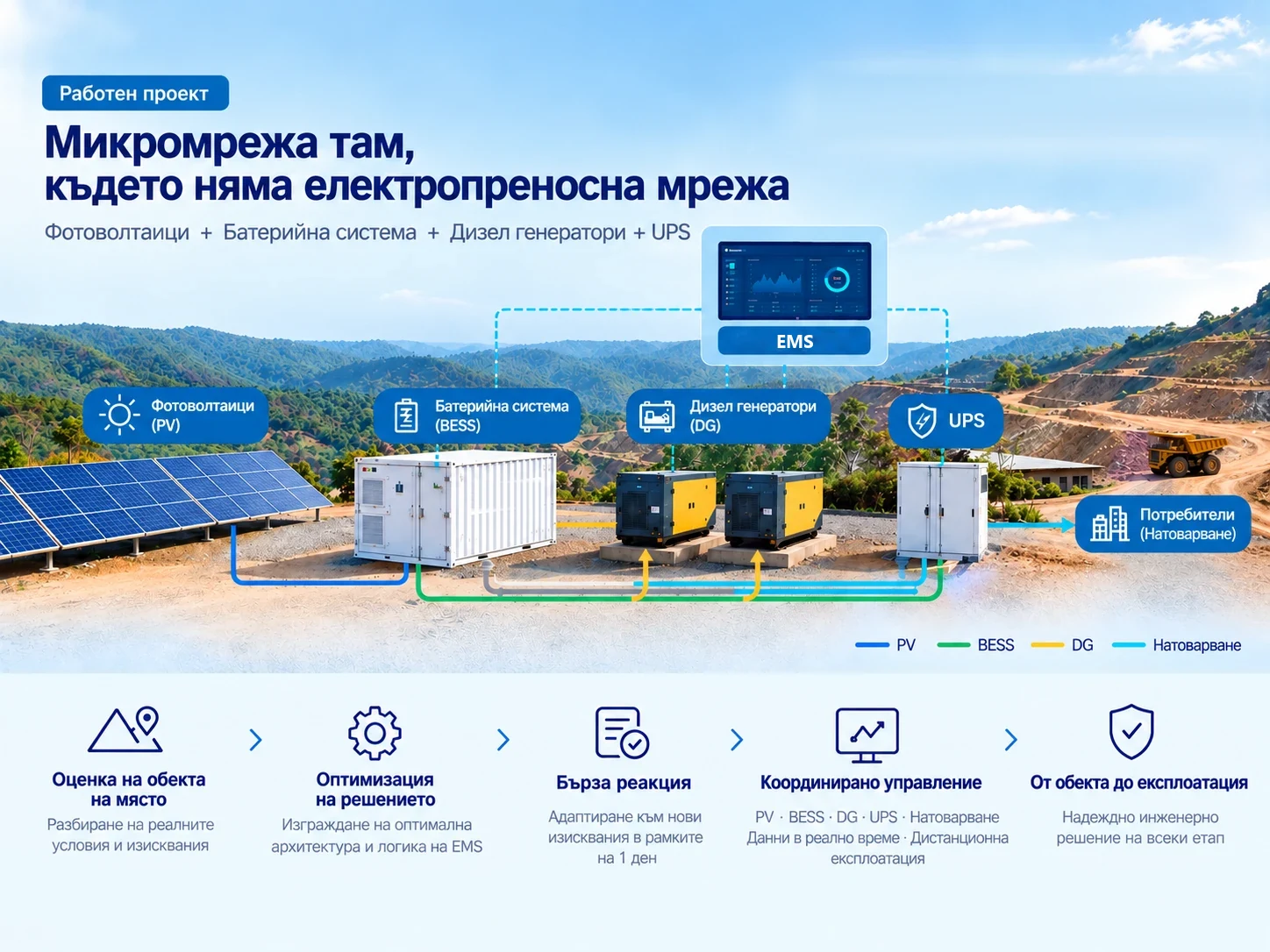
An off-grid (islanded) microgrid is a self-contained electrical system that generates, stores and distributes energy for the loads of a single site, with no connection to the national grid. A typical setup has five parts:
- Solar PV — the main and cheapest source during the day.
- Battery energy storage (BESS) — stores the solar surplus and powers the site in the evening and in cloudy weather.
- Diesel generators (DG) — the backup when the battery is depleted or the load exceeds what solar and the battery can cover.
- UPS — uninterrupted power for critical loads: control, communications, monitoring.
- EMS (energy management system) — the “brain” that decides at every moment which source runs and how much.
How they work together over a day
Daytime, sunshine. Solar PV powers the loads and the surplus charges the battery. The generators stay off.
Evening and night. The battery takes over the load. The EMS watches the state of charge (SoC) and starts a generator when it drops to the set threshold.
Cloudy days and peaks. When solar and the battery are not enough — a large motor starting, or several cloudy days in a row — a generator starts and both powers the site and recharges the battery.
Loss of a source. The UPS keeps critical systems running without interruption while the EMS switches to another source.
Why a generator plus a battery, not a generator alone
A diesel generator running around the clock is lightly loaded most of the time. At low load the engine is inefficient: it burns more fuel per kilowatt-hour and wears faster (carbon build-up, so-called “wet stacking”). In a microgrid the generator runs less often, and when it runs it stays in its efficient range, because the surplus goes into the battery.
- fewer engine hours and less frequent servicing;
- less fuel and fewer deliveries to a remote site;
- silence and no exhaust for most of the day;
- redundancy: if one generator fails, the second one and the battery take over.
The role of the EMS
Without coordination each source works “on its own” and conflicts appear: a generator starting while the battery is full, or an inverter curtailing solar because the energy has nowhere to go. The EMS collects data from every part in real time and controls them by set priorities:
- solar energy first;
- then the battery, within the allowed charge range;
- generators only when needed, rotated to even out engine hours;
- when energy is short — shedding non-essential loads to keep the important ones powered.
The same data is available remotely: production, charge, fuel use, engine hours, alarms. Many problems are spotted and solved without anyone travelling to the site.
Where a microgrid starts
A good microgrid does not start from an equipment catalogue but from the site:
- On-site assessment. What loads there are, when they run, what the peaks are, how much sun there is, where panels and containers can go, how fuel is delivered.
- Sizing and logic. How much PV power, what battery capacity, how many and which generators, which loads are critical. This is also where the EMS rules are defined.
- Build and commissioning. Installation, wiring, protection settings and testing every mode — including the loss of a source.
- Operation. Remote monitoring and, when needs change, quick retuning of the logic without replacing equipment.
When it makes sense
A microgrid pays off most where:
- there is no grid, or connecting to it is expensive and slow;
- the site currently runs on diesel generators only;
- fuel is hard to deliver — mountain and remote sites;
- there are critical loads that must not lose power.
Typical examples are quarries and mines, construction sites, farms and irrigation systems, mountain huts and tourist sites, telecom and measurement stations.
In short
Solar provides the cheap energy, the battery moves it through time, the generator is the insurance, the UPS protects what matters most, and the EMS turns all of it into one system. The result is stable power where there is no grid — with less fuel, less noise and full visibility of what is happening on site.