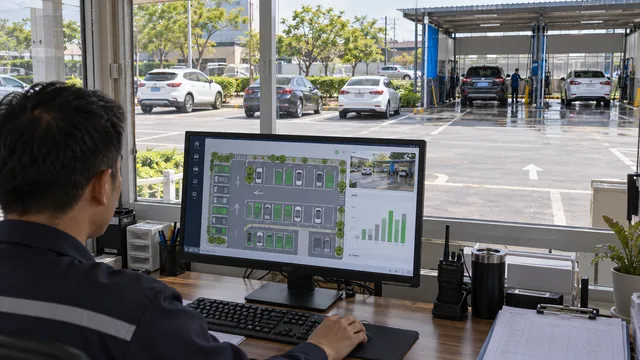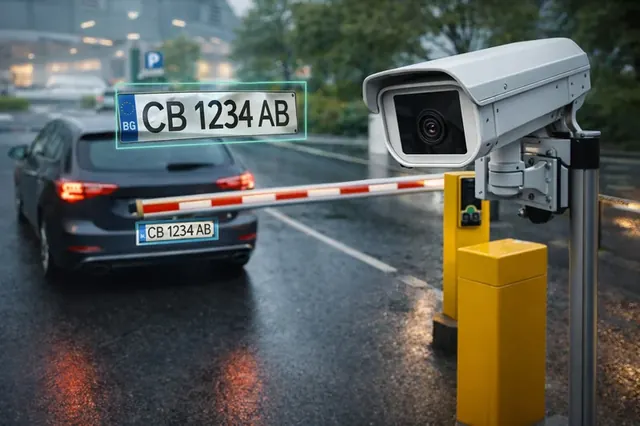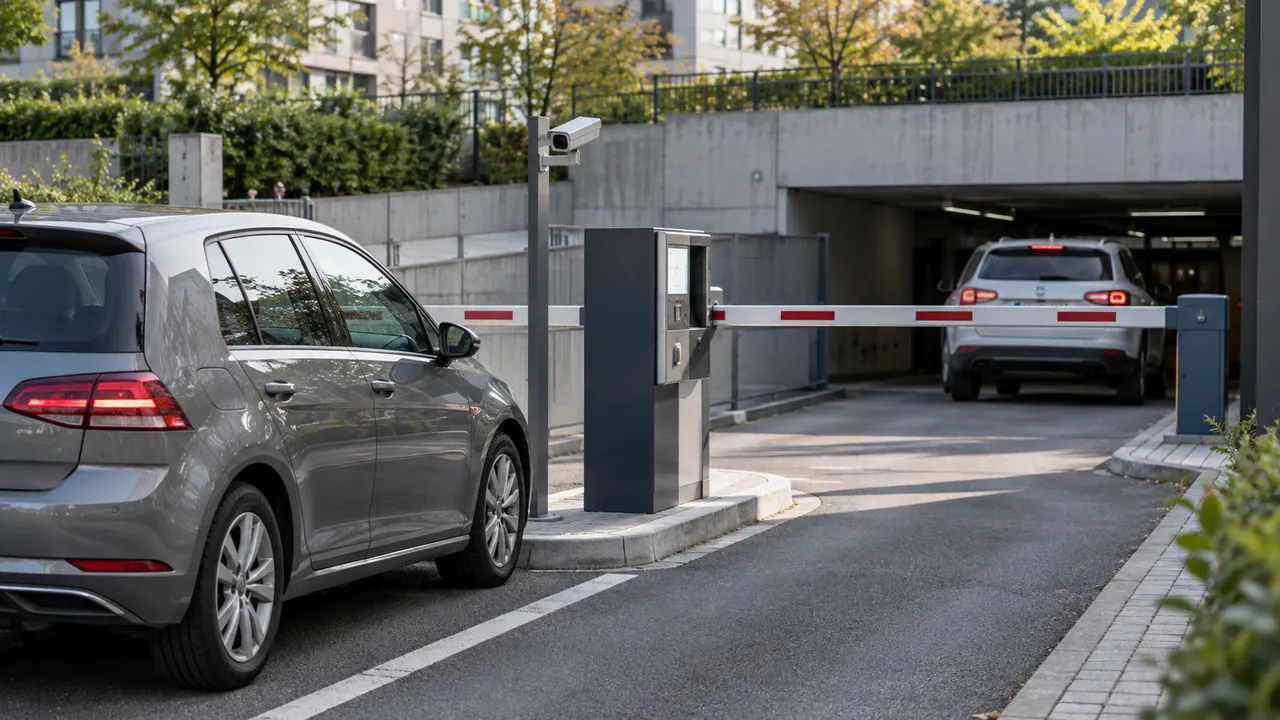
An automated parking lot links entry, stay and exit into one process. License plate recognition (LPR) cameras, barriers and counters exchange events with management software. The exact configuration follows the mode of the site — staff access, a residential complex, visitors or subscribers.
This article tells how a visit unfolds, what space counting shows, and which decisions are worth considering at the planning stage. The practical example is the system that Specomsys is developing at the moment. It is its own project and is still in development: for now it runs as a pilot, and its results are not final.
How a visit unfolds
- The vehicle approaches the barrier. The camera captures the plate and the software reads the number.
- The number is checked against the access list: permanent user, temporary access, or a number without entry rights.
- On a match, the open command reaches the barrier. For an unknown number the barrier stays closed, and the driver can contact an operator or use a backup way to open.
- The event is recorded with an image, number, direction, date and time.
- The barrier closes only after the vehicle has passed.
Plate recognition links the entrance to the exit: the system knows when a vehicle entered without relying on a paper ticket or a card. Accuracy, however, is not guaranteed in advance — it depends on the camera angle, lighting, weather and the condition of the plate, and is verified on site.
Counting spaces
Free spaces are most often derived from the difference between entries and exits. This is simple and works well, but errors accumulate: if one vehicle is not recognized or passes without being detected, the count gradually drifts from reality. That is why manual correction and periodic comparison with the actual situation are provided.
The occupancy obtained this way can be shown on a board at the entrance, in the web panel or on the phone of the person responsible. The board helps a driver decide whether to enter, but it does not guarantee that a particular space will be free.
What such a system includes
- LPR cameras at the entrance and exit, with illumination for night operation;
- barriers with an arm matched to the lane width and crush protection;
- a server that keeps the access lists and the log and sends commands to the barriers;
- a web panel for managing rights, viewing events and reports;
- backup ways to open — a card, a PIN or a button at the operator;
- power and network between the entrances and the server.
Rights and reports
In the system under development, one client has one file, to which different identifiers are linked: vehicle plates, cards, PIN codes and phones. Rights are set jointly — by entrance, period, days of the week and hours. In a stricter mode two different factors can be required, for example a plate and a card.
The log keeps every pass with an image, and the reports show load by hour and day. These data help the site owner plan spaces and see when the lot actually fills up.
What else matters
- Barrier safety. Closing is controlled by a loop or photocell signal, not by a timer.
- Operation when the network is down. The entrance must not stop when the link to the server drops; a local list and later synchronization of events are needed.
- Emergency opening. On a fire alarm or evacuation the barriers open, and the procedure is tested before launch.
- Personal data. License plates and images can be personal data. A retention period and a circle of people with access are defined.
- Queuing space. If the queue in front of the barrier spills onto the road, the problem lies in the planning, not in the software.
- Cable routes. Conduits for power and data are laid before the paving.
In development — open to conversation
The system is in development and is refined from real-world experience. The most valuable input comes from people who run parking lots every day: what they are missing and which cases have caused them trouble so far. If the topic interests you, you can write through the Specomsys contact form.