Lower costs than a full-time IT specialist
A full-time, qualified IT specialist is expensive: salary, social contributions, training and paid leave all add up. With outsourcing, a business pays a fixed monthly fee that covers a team of specialists with different skill sets, instead of one person whose knowledge is inevitably limited in some areas.
Less business downtime
Every hour without a working network, point-of-sale system or accounting software is lost revenue. Under a contract with a clear SLA, response times are agreed in advance — typically 2–4 hours, and down to 1 hour for critical systems. Problems are often detected and fixed before they bring work to a halt.
Access to broader expertise
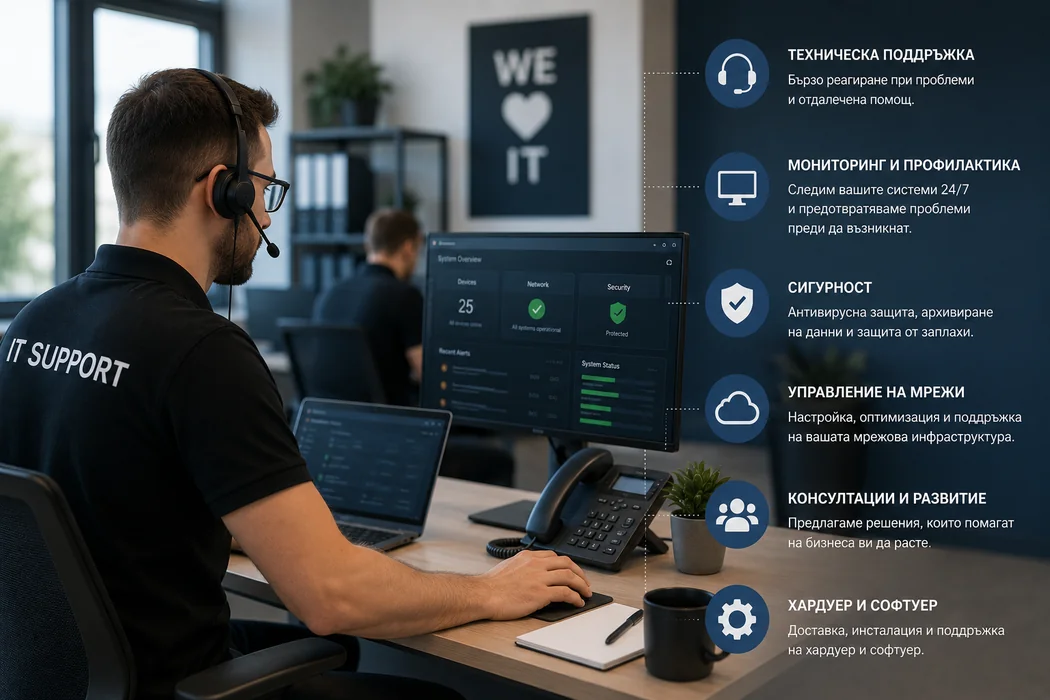
A single in-house employee rarely knows networks, servers, cybersecurity and backup systems equally well. An external team has people specialized in each of these areas, along with experience gained across many different organizations and situations.
Predictable, planned costs
A fixed subscription fee makes the IT budget predictable, with no surprise invoices after an outage. Support costs are planned month by month instead of being absorbed each time something breaks.
Safer data and systems
Regularly updated systems, working backups and properly configured protection sharply reduce the risk of data loss or downtime caused by an attack. Preventive checks uncover weak spots before they turn into real problems.
More time for the core business
When the IT infrastructure is in the hands of a team that monitors it continuously, owners and staff can focus on sales, customers and growth instead of hunting for someone to fix the network or the printer.
Flexibility as the business grows
When a new location opens, workstations are added or new systems are introduced, an external provider can scale support without the need to hire additional staff.
What to clarify in the contract
The benefits only materialize when the terms are clearly defined. Before choosing a support model, it is worth clarifying:
- which systems and devices are covered and which are billed separately;
- response and resolution times (SLA) depending on how critical an issue is;
- how backups are made and tested;
- who holds the passwords, licenses and network documentation;
- how support is handed over if the contract ends.
Outsourced support is not the only possible model. Larger organizations often combine it with an in-house IT employee who knows the day-to-day processes, while narrower specialist tasks are handled externally.