Protocol and standards
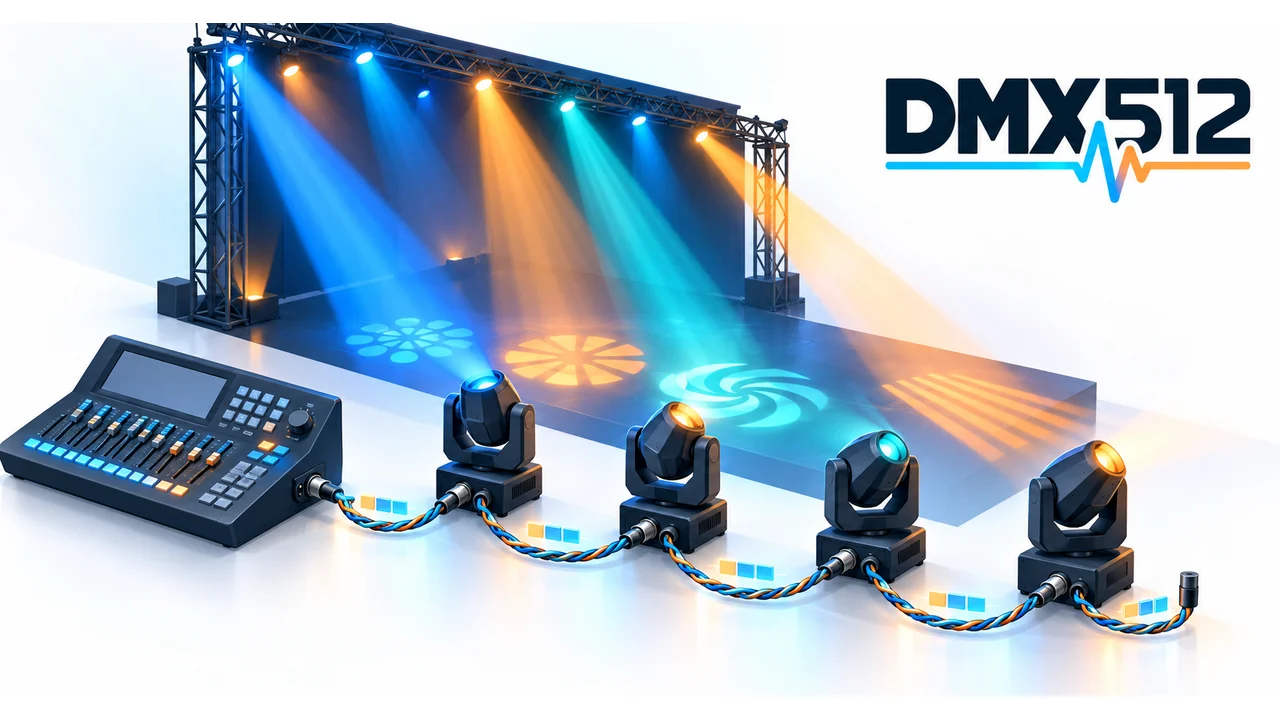
DMX512 sends lighting-control values, commonly to dimmers, LED fixtures and moving heads. Values are 8-bit, 0–255; channel identity is the slot's position in a packet. The fixture decides how to convert values into light or movement. Classic DMX is a one-way stream over an RS-485-based link.
USITT editions date from 1986 and 1990; DMX512-A developed as ANSI E1.11, including 2004 and 2008 editions and subsequent reaffirmations. A revision and a reaffirmation are different; check ESTA's current catalogue. Related standards include E1.20 RDM, E1.31 sACN, E1.33 RDMnet and E1.27 cabling.
Wiring and connectors
Use a daisy-chain data bus with suitable cable and an end-of-line terminator, commonly 120 Ω across the data pair at the far end. A passive Y is not a substitute for an active splitter. A splitter regenerates data onto separate branches; it does not power the lamps.
The traditional electrical limit is 32 unit loads, not universally 32 fixtures. Maximum length depends on cable, joints, equipment and interference; 400 m is not a guaranteed universal limit. XLR-5 is the standard portable connector: pin 1 common, 2 data−, 3 data+, with an optional second pair on 4/5. Widely used XLR-3 is not the standard DMX connector. 8P8C arrangements and proprietary pinouts must be checked; the presence of an RJ45-shaped connector does not mean Ethernet.
Packets and refresh
DMX uses 250 kbit/s, eight data bits least significant first, no parity and two stop bits. A serial slot takes 44 μs. A packet begins with break, mark-after-break, a start-code slot and up to 512 data slots. Common transmitter minima are 92 μs break and 12 μs MAB; receiver acceptance limits differ.
A full packet takes about 22.7 ms, giving around 44 updates/s before additional pauses. Shorter packets can be faster within permitted timing and fixture support. The minimum break-to-break interval can be met using an appropriate mark interval; adding dummy channels is not mandatory. Packet refresh does not by itself determine optical or mechanical response.
Universes and addressing
A universe contains up to 512 eight-bit slots. A physical output carries one selected universe; multiple outputs can repeat the same universe. A claim of 1024 channels normally means two universes, not one standard 1024-slot packet.
A fixture personality defines its footprint. An eight-slot fixture starting at 17 uses 17–24. Independent functions need non-overlapping addresses, but deliberate overlap can make compatible fixtures follow identical values. Coarse/fine pairs can provide 16-bit control across two slots.
RDM and IP transport
Normal levels use start code 0x00; other codes identify other packet types. RDM uses 0xCC and a bidirectional exchange for supported discovery, addresses, personalities and diagnostics. It requires compatible line behaviour and splitters supporting the return path. Bias must follow the applicable equipment requirements, not one universal resistor or voltage.
Art-Net commonly uses UDP 6454; ArtDmx still carries data in Art-Net 4. Its supported Port-Address scheme provides 32768 combinations. sACN commonly uses UDP 5568 with universe numbers 1–63999, multicast or supported unicast, priorities and synchronisation. Equal-priority/source handling follows the protocol. Wi-Fi can carry these protocols but introduces variable delay and multicast constraints; suitability must be tested.
Diagnostics and safe use
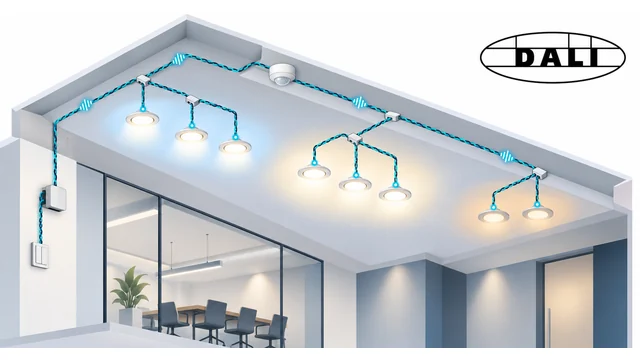
Check termination, cable, polarity, loading, personality, addresses, grounding and RDM compatibility. Verify the fixture's loss-of-data behaviour rather than assuming it will switch off. Basic DMX level data has no general payload checksum or acknowledgement. It is not a safety control system for hazardous actions. DALI offers a different model of individual gear, groups, scenes and feedback for general lighting; gateways can integrate both.