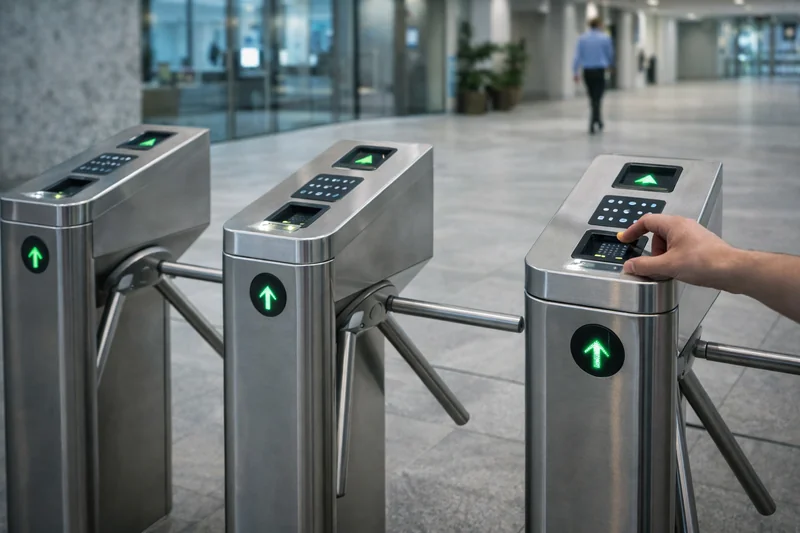
A door with a card reader controls who unlocks it, but not how many people walk through while it is open. Where that matters, turnstiles are used. They physically enforce the principle of "one credential, one person": two people cannot pass on a single card. This makes turnstiles the foundation of a genuine entry control regime in manufacturing plants, warehouses, gyms and other controlled-access sites.
Beyond security, a turnstile is also the most accurate source of data on actual hours worked. Every entry and exit is recorded, and nobody can clock in on behalf of a colleague. This article looks at how such a system works, what it should be able to do, what it consists of and how it is sized.
When a door with a reader is not enough
With an ordinary access-controlled door, one employee can unlock it and let several others in behind them. In an office that is often acceptable, but in a factory or warehouse it causes real problems: nobody knows exactly who is on site, time records are inaccurate, and during an evacuation there is no reliable list of people present. At a sports facility, the same gap means entry without a membership. A turnstile solves these problems by letting exactly one person through for each valid identification.
What the system should be able to do
- One credential, one person: no tailgating in pairs.
- Identification by RFID card or tag, and for higher security a combination of card and PIN.
- Schedule-based rights: access according to shift and working hours; outside the schedule the system denies entry or requires confirmation.
- Anti-passback: after entering, a card cannot be used to enter again until an exit has been registered.
- Visitors and contractors: temporary cards valid for the day and restricted by zone.
- Time and attendance: actual shift hours, late arrivals, early departures and overtime, with export for payroll.
- A live list of people on site: how many and which people are present at any moment.
- Evacuation mode: on a fire signal or power failure the arms release and passage is free.
- Autonomous operation when the network is down.
- Throughput of up to about 30 people per minute per unit.
- A separate passage for people with disabilities and for goods.
What the system consists of
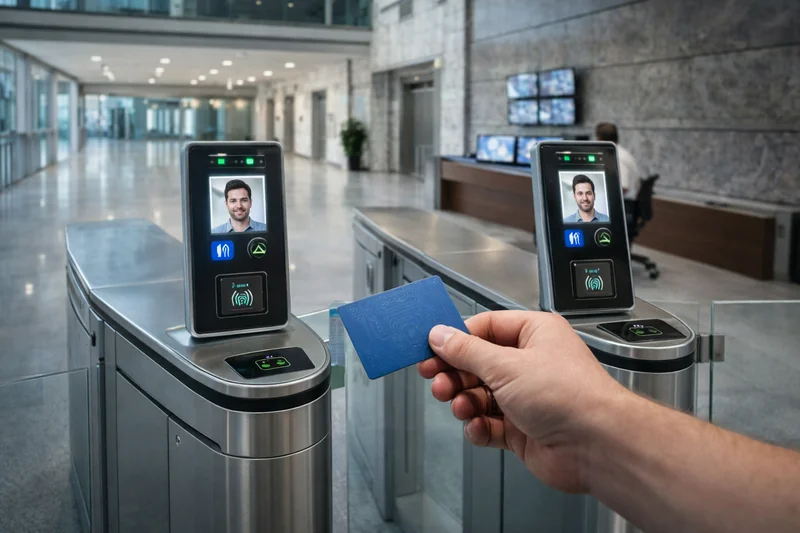
- Turnstiles: typically two tripod turnstiles for indoor or sheltered outdoor installation. Speed gates are used for more representative entrances, and full-height turnstiles for unattended outdoor entrances.
- RFID readers: operating at 13.56 MHz, built into the housing, with light and sound indication of whether passage is allowed.
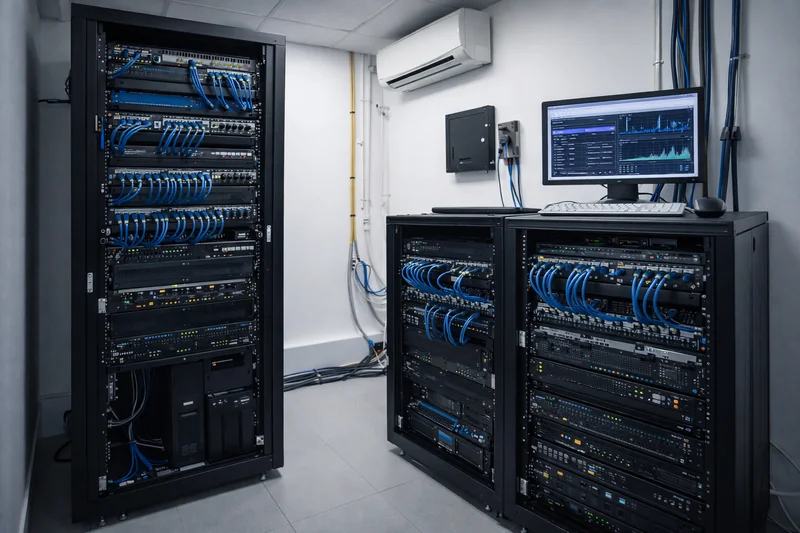
- A controller with a local database: stores users and rights, keeps working when the network is down and buffers events until the connection is restored.
- Management and reporting software: enrolling employees, schedules, visitors, attendance reports and lists of people present.
- Backup power: the turnstiles run on 12/24 V DC and can be backed up with a UPS.
- Installation, anchoring and configuration: the turnstile is firmly fixed to the floor, and directions, schedules and evacuation mode are configured and tested.
- Training for security, reception and the staff who prepare time and attendance reports.
Technical specifications
| Parameter | Specification |
|---|---|
| Type | tripod turnstile; speed gates and full-height turnstiles as options |
| Mechanism | electromagnetically controlled direction of rotation, smooth return, passage counter |
| Readers | RFID 13.56 MHz, built in, with light and sound indication |
| Controller | local database of users and rights, offline operation, event buffer |
| Power | 12/24 V DC, UPS backup possible |
| Throughput | about 25–30 people per minute per unit |
| Accessibility | separate gate or wide passage |
Time and attendance and the list of people on site
Because every passage is linked to a specific person and direction, turnstile data gives a true picture of each shift: who arrived on time, who was late, who left early and how much overtime was worked. Reports are exported for payroll and replace manual attendance sheets, which are a frequent source of disputes.
The live list of people on site is just as important. During an evacuation, the person responsible for safety can immediately see how many and which people were on the premises and compare that with those at the assembly point. That is why such a list is a requirement in many safety procedures.
Evacuation and safety
A turnstile must never become an obstacle in an emergency. On a signal from the fire alarm system or on loss of power, the arms release and people pass freely. Tripod turnstiles often also have a drop-arm function in which the top arm falls to open the passage. The separate wide passage for people with disabilities and goods also serves as an additional evacuation route, but it needs its own control so that it does not become a way around the regime in normal operation.
Sizing: how many turnstiles are needed
The number of turnstiles is determined by the busiest moment, usually the shift change. If one unit passes about 25 people per minute, 200 workers arriving for a shift will pass through two turnstiles in about 4 minutes. If the same 200 people must pass through a single turnstile, it takes about 8 minutes and a queue forms at the entrance. It is also wise to account for the previous shift leaving at the same time.
Possible extensions
- A camera that captures the face at every passage and links the image to the record.
- A visitor card dispenser at reception.
- A terminal with a display showing employees their remaining leave and hours worked.
- Integration with access control in the other areas of the site.
Common planning mistakes
- Sizing for average load. The number of turnstiles must match the shift change, not the average number of people per hour.
- No separate passage. Without a wide passage, people with disabilities, trolleys and goods cannot get through, and staff start leaving the service door open.
- Anti-passback without exit registration. If exits do not go through a turnstile or reader, the function blocks cards the next day.
- Unprotected outdoor installation. A tripod turnstile outdoors without a canopy is exposed to rain and ice; full-height models are better suited to such entrances.
- Untested evacuation mode. Release of the arms on a fire signal and on power loss must be tested on site.
- No visitor procedure. Without temporary cards, visitors are let in through the service passage and the regime loses its purpose.
Quick checklist
- Has the number of turnstiles been calculated for the shift change?
- Is there a controlled separate passage for people with disabilities and goods?
- Are exits registered as well?
- Is evacuation mode linked to the fire alarm and tested for power loss?
- Do the controller and turnstiles have backup power?
- Is there a defined procedure for visitors and contractors?
- Has it been agreed which attendance reports payroll needs?
A turnstile system turns entry control from a formality into real control. When it is correctly sized and linked to evacuation, it provides security at the entrance, accurate working-time data and a reliable list of the people on site, all at once.